From Paddock to Product: Turning Biological Discovery into Real-World Grain Protection
- Skye Raward

- Feb 6
- 5 min read
Building a Biological Backbone for Fall Armyworm Control
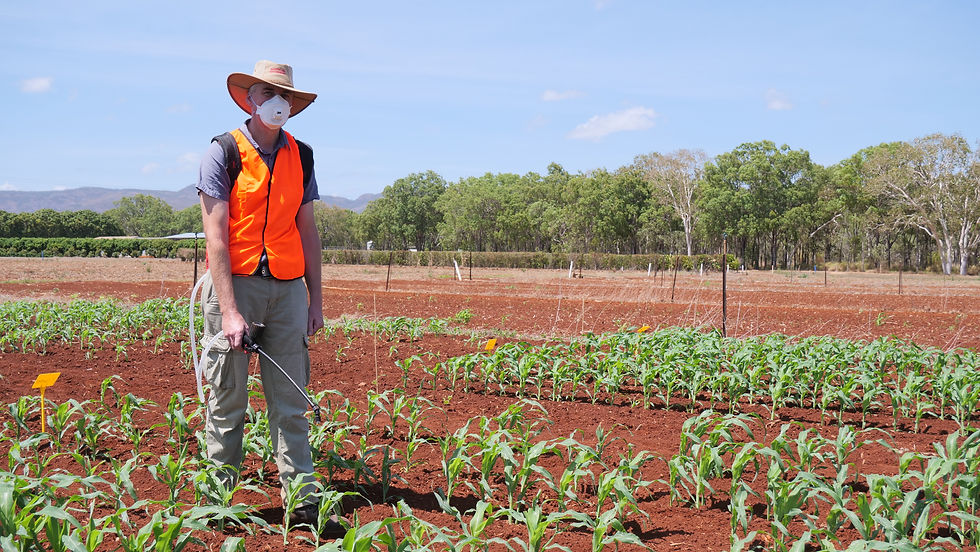
For Dr Ian Newton, innovation didn’t begin with a startup idea or a commercial ambition. It began in the paddock, standing alongside growers in Far North Queensland as a new pest tore through crops and existing tools failed to keep up.

With more than 25 years’ experience in applied entomology, Ian is deeply embedded in Australia’s grains research system. As a Principal Entomologist, his career has focused on insect pathogens, biological control, and integrated pest management. But when fall armyworm arrived in Australia, resistant to many chemical options and spreading rapidly, it exposed a critical gap.
That gap became the foundation for NewFaw, a biological pesticide built around a naturally occurring Queensland fungus that showed rare, real-world effectiveness against one of the grains industry’s most urgent threats.
What follows is a Q&A drawn from a recent conversation with Farmers2Founders Program Manager Phil Doran, exploring how Ian navigated the transition from lab-based research to field validation, and what meaningful support looks like for researchers stepping into commercialisation for the first time.
Q&A with Dr Ian Newton, Founder of NewFaw
Phil: Ian, you’ve spent decades in applied entomology. Where did your work on fall armyworm really begin?
Ian: Most of my career has been focused on insect pathogens and biopesticides. Early on, I worked extensively on Helicoverpa, which is very similar to fall armyworm. Same family, similar resistance issues, similar migration behaviour.
When fall armyworm arrived in Australia, it came through Far North Queensland first. I was right there, speaking directly with farmers who were experiencing crop failures almost immediately. Chemical controls weren’t holding up, and growers were looking for alternatives. That’s what prompted me to start seriously looking for a biological solution.

Phil: You weren’t just studying the problem, you were seeing it unfold in real time.
Ian: Exactly. We were on the front line. Farmers were distraught and asking what options they had. What stood out was what we started seeing naturally in the field. During collections, we kept finding this fungus, Metarhizium rileyi, infecting fall armyworm populations. In some crops, you’d walk through and see dead larvae everywhere. It was causing natural epizootics. That was a real turning point. This wasn’t something artificially introduced. The pathogen had found the pest on its own.
Phil: And that observation became the basis for NewFaw?
Ian: Yes. When we looked at the global literature, this fungus is essentially the only pathogen known to cause natural epizootics in fall armyworm anywhere in the world.
There are chemical controls available, but they’re expensive and resistance builds very quickly. Integrated pest management relies on having non-chemical options to slow that resistance. For fall armyworm, that biological backbone simply didn’t exist. That’s the gap NewFaw is addressing.
Phil: Taking something from observation to application is rarely straightforward. What were the biggest challenges moving from lab to field?
Ian: The first hurdle was culturing the pathogen. It’s quite finicky. Each strain behaves differently, and getting it off an insect and into a stable artificial culture takes time.
Then there’s scale. You can’t do meaningful field trials without producing enough product, so we had to work on mass culturing in parallel with lab assays. That allowed us to move into field trials as soon as possible.
And that’s critical. The lab is very good at answering narrow questions, but it doesn’t tell you how something behaves in real-world systems.
Phil: You’re a highly experienced researcher, but stepping into commercialisation is a different environment. What surprised you most?
Ian:How hard it.. As a scientist, you’re very focused on whether something works and whether it’s reproducible. But once you step into commercialisation, you suddenly need to understand finance, markets, customers, investors, and regulatory pathways. That complexity was a real eye-opener.

Phil: How did Farmers2Founders fit into that transition?
Ian: The biggest shift for me was how I thought about the customer.
Initially, I saw the farmer as the customer. Through the program, it became clear that while farmers are the end users, the commercial customer may actually be a business that manufactures, registers, and distributes the product.
That broader thinking didn’t come naturally, but it was essential. It helped clarify how NewFaw could realistically reach the field at scale.
Phil: That insight has shaped NewFaw’s commercial pathway. What does that look like now?
Ian: We’re likely pursuing a licensing pathway.
We’ve developed the IP. We know how to produce the fungus, how to apply it, and how it performs in the field. What we don’t have is manufacturing infrastructure, regulatory capability, or global marketing reach.
Partnering with established companies is the fastest way to get this into growers’ hands, and speed matters. Farmers are asking for this now, not years down the track.
Phil: For Queensland researchers, HDRs, or early-stage founders working on grains problems, what advice would you give?
Ian: Get into the field early and start small. The lab can give you confidence, but real learning happens in the paddock. We started with very small trials, just a handful of plants. That’s where you learn how the pest behaves, how the crop responds, and how the product actually performs.
You also need to understand the market. Who will use this? When will they use it? How will it fit into existing systems? Those questions matter just as much as the science.
Phil: Finally, what does meaningful success look like for you and NewFaw?
Ian: Being able to tell a grower that it’s on the shelf next season.
More broadly, it’s about giving the grains industry another option. A biological backbone that reduces reliance on chemistry and gives farmers peace of mind.
Fall armyworm isn’t just an Australian problem. It’s global. If this product can be adopted here and overseas, that would be meaningful success.

Closing reflections
Ian’s journey reflects a pathway many grains researchers and early-stage founders are navigating — moving from strong science toward real-world impact, without rushing or oversimplifying the work.
For those working on grains challenges, the transition from research to adoption often hinges on early field validation, realistic commercial pathways, and access to the right partners at the right time.
Through its startup acceleration programs, Farmers2Founders supports researchers, startups and scaleups to translate agrifood innovation into solutions that can be adopted by industry. These programs are designed to complement — not replace — existing research pathways, providing practical support for teams exploring what comes next.
👉 Learn more about upcoming opportunities:https://www.farmers2founders.com/build
This work is delivered as part of Farmers2Founders’ ongoing partnership with the Grains Research and Development Corporation (GRDC), supporting innovation that strengthens the long-term productivity and sustainability of the Australian grains industry.https://grdc.com.au/