Lab to Land: Dr Hima Haridevan on Translating Research into Real Agrifood Impact

For Dr Hima Haridevan, agrifood innovation doesn’t begin with a startup idea or a pitch deck. It begins in the lab, with materials, systems, and a fundamental question that many researchers quietly wrestle with: how does this work beyond controlled conditions?

Based at the University of Queensland, Hima is a translational materials scientist specialising in making bio-based materials more accessible and cost-effective for sustainable living. As co-founder of EcoSprout, she is transforming agricultural waste into biodegradable biogels designed to support soil and crop health.
Her expertise lies in valorising biomass resources such as cellulose and lignin to produce green chemicals and bio-based polymer composites, bridging rigorous materials science with practical agrifood applications.
EcoSprout emerged not as a departure from research, but as a translational pathway alongside it.
What follows is a Q&A drawn from a recent conversation with Farmers2Founders Program Manager Phil Doran, exploring how Hima has navigated that space between lab and land, and what meaningful support looks like for researchers considering their next step.
Q&A with Dr Hima Haridevan, Co-founder of EcoSprout
Phil: Hima, to start us off, can you introduce yourself and the problem you’re working on through EcoSprout?
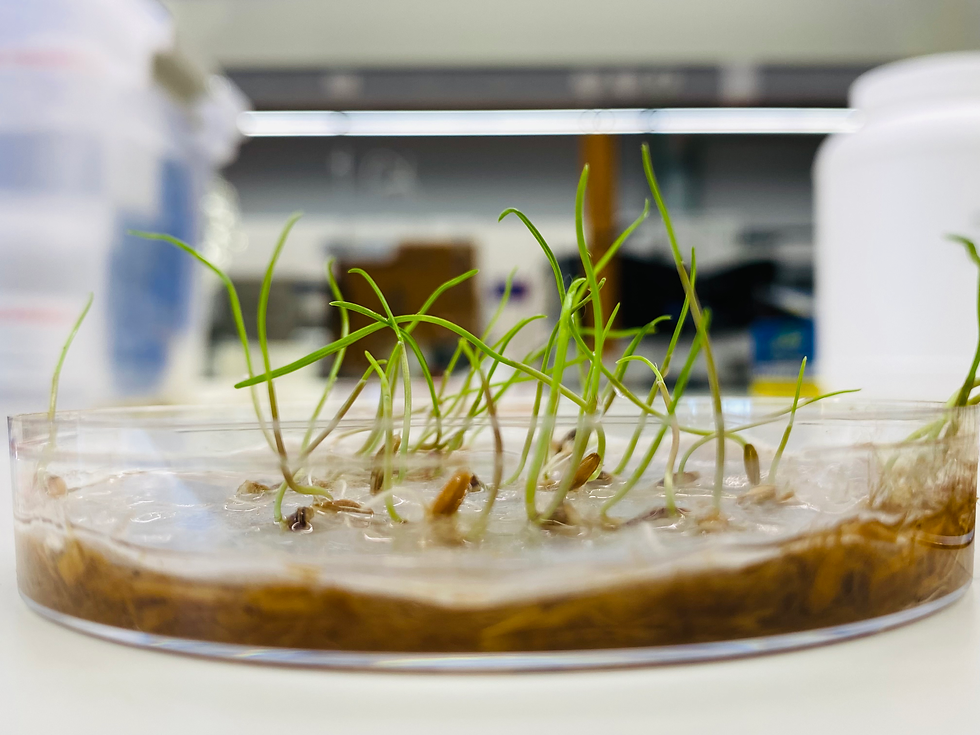
Hima: I’m an Early Career Researcher (ECR) from the School of chemical engineering at The University of Queensland, a materials scientist working in bio-based materials, particularly focused on how we can take agricultural residues and turn them into something genuinely useful for sustainable agriculture. Through EcoSprout, we’re developing biodegradable biogels using a circular, water-free manufacturing process.

At its core, the problem we’re addressing is about under utilised biomass and the pressure agriculture is under to improve soil health, manage water more efficiently, and reduce reliance on microplastic-based inputs. EcoSprout sits where those challenges intersect.
Phil: You’re deeply embedded in research. What prompted you to start thinking beyond the lab?
Hima: I could see the technical potential of the materials early on, but that’s only one part of the picture. Research is very good at answering, can this work? The harder question is how does this work in the real world?
Outside the lab, people aren’t looking at novelty or performance metrics in isolation. They want to know whether something fits into existing systems, whether it creates friction, and what problem it actually solves for them. That gap between scientific proof and practical application is what pushed me to explore translation more seriously.
Phil: Was there any hesitation in taking that step, even informally?
Hima: Definitely. As a researcher, you’re trained to be careful and precise, and that’s important. But it can also make you hesitant to engage before everything feels fully defined.
What helped was realising that early engagement didn’t mean committing to a commercial outcome. It meant learning. Understanding how other people see the problem and where the constraints actually sit.
Phil: How did Farmers2Founders fit into that learning phase?
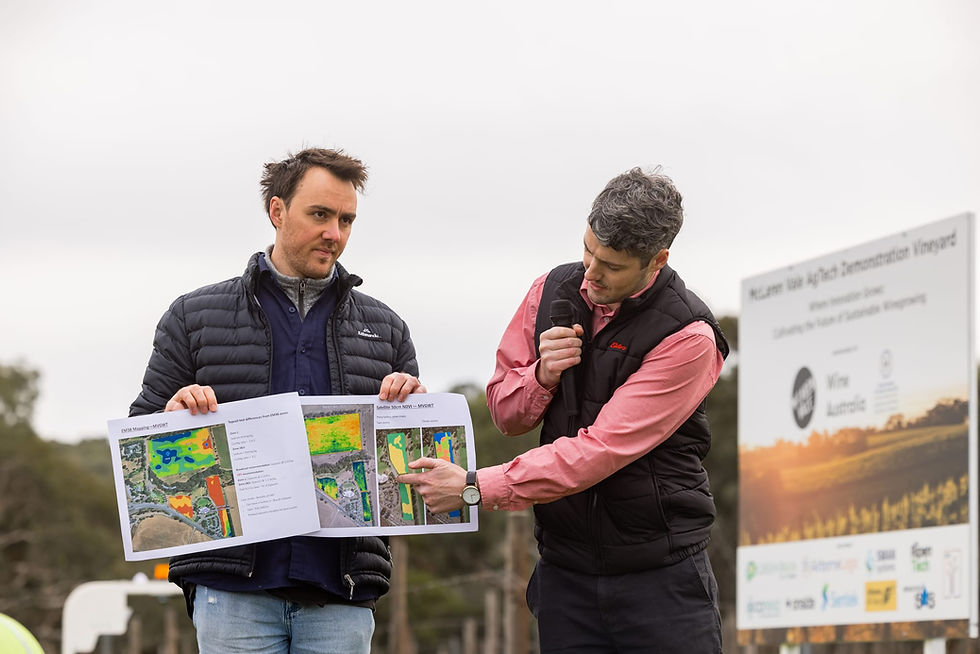
Hima: It felt very much like lived experience rather than a traditional program. Working with you and Pete gave me a space where I didn’t need to perform certainty.
“Having conversations with people who understand both research and application accelerated my understanding in a way I couldn’t have done alone,” Hima reflects. “It gave me clarity without pressure.”
It wasn’t about being pushed to commercialise or having all the answers. It was about asking better questions earlier, and understanding what real validation might look like for this kind of technology.
Phil: What changed in your thinking as a result of that support?
Hima: The biggest shift was moving from focusing purely on the material to thinking about the system it would sit within.
Before, my thinking was very much about performance and proof. Now, I think more about integration, adoption, and outcomes. That helped me separate showing the product from demonstrating impact.
Through that process, EcoSprout’s pathway toward pre-commercial validation and pilots became much clearer, while still staying grounded in the integrity of the science.
Phil: How has that influenced the work you’re doing now?
Hima: It’s shaped how we’re developing bio-gel fertilisers and biomass-based mulch films, in collaboration with Professor Darren Martin. The focus is on scalable, economical solutions that can realistically be adopted in agricultural systems.
In research, success is often measured by reproducibility and peer review. Outside the lab, success is about outcomes. Improved soil function. Reduced waste. Clear value at the system level.
That mindset now underpins how we approach pilots, partnerships, and any future steps toward commercialisation.
Phil: For HDRs or early-career researchers reading this, what advice would you offer?
Hima: I think many researchers feel they need to have a clear endpoint before they start engaging. In reality, you don’t.
You don’t need a startup plan, and you don’t need to step away from academia. But having early conversations with people who understand both research and application can save a lot of uncertainty later.
What matters is finding environments that respect complexity and allow you to learn without pressure.
Phil: And finally, how do you see the next phase for EcoSprout?
Hima: We’re still very much in a validation phase. The focus is on learning, testing assumptions carefully, and building the right partnerships.
If this work progresses further, it needs to do so in a way that’s scientifically sound, economically viable, and genuinely useful for agriculture. That’s what we’re working toward.
Closing reflections
Hima’s journey reflects a pathway many researchers and early-stage founders are quietly navigating, moving from strong science toward real-world impact without rushing or oversimplifying the work.
For Queensland-based HDRs, early-career researchers, and agrifood founders, her experience shows that support doesn’t have to mean pressure, and progress doesn’t require certainty. Often, it starts with the right conversations, the right people, and a space where learning through experience is not only allowed, but encouraged.
In 2026, Farmers2Founders will run a new intake of advanced pre-accelerators for early-stage Queensland founders ready to validate, pressure-test and accelerate their path to market.
👉 Submit your Expression of Interest here: https://airtable.com/appg8u3FYyP2wMOtc/pagUtH6ZxmHi9UbUn/form